
Getting a welder's qualification recognised in Germany
ManBe Group · 11 September 2026 · 3 min read
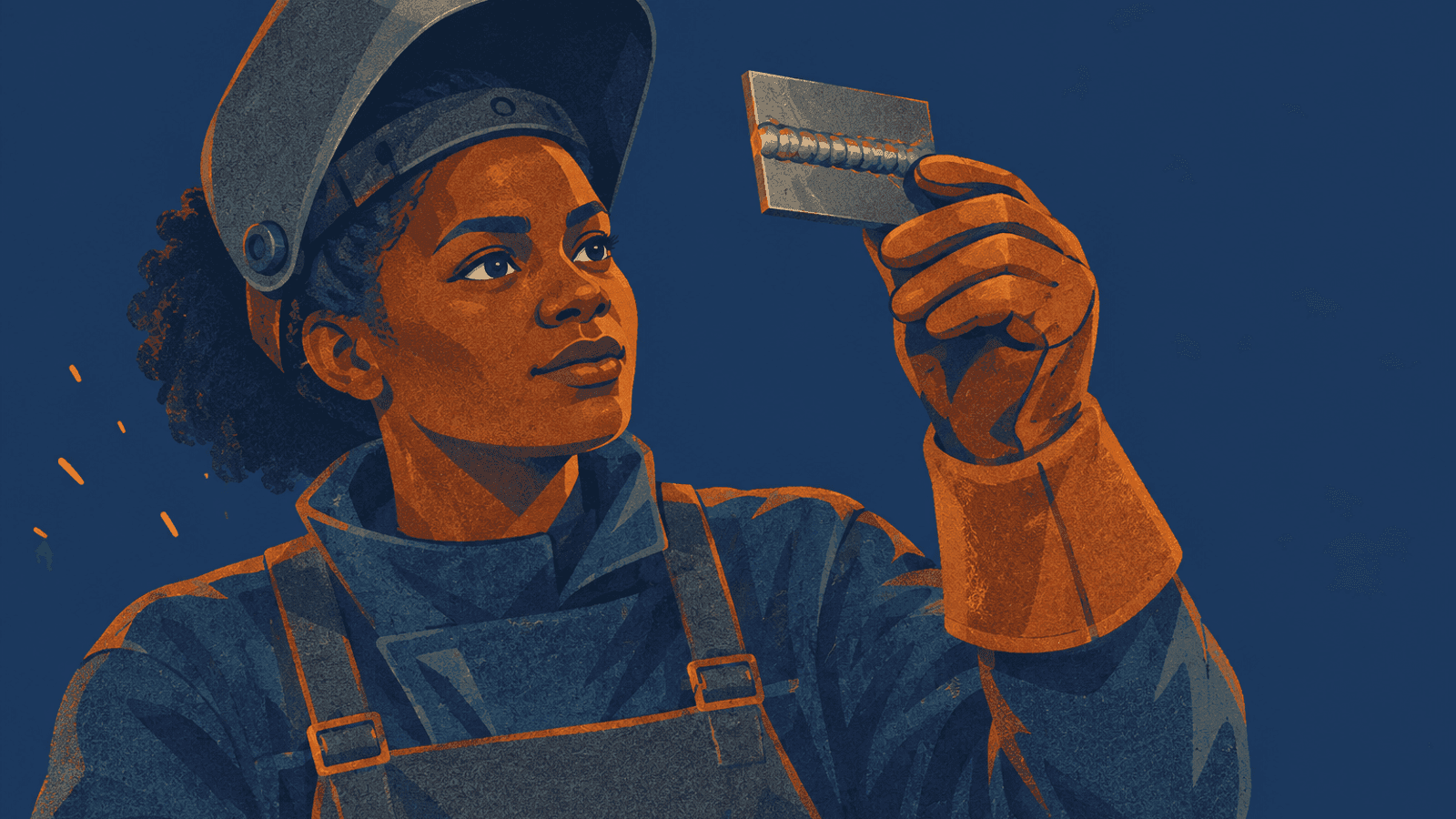
German fabricators and shipyards can hire non-EU welders. What stops most of them is not the visa — it is recognition. Under the Skilled Immigration Act the route runs through the qualification, and if the qualification cannot be shown to be equivalent to a German one, the rest of the file has nowhere to go.
This is the single longest item in a German hire, and the one most often started last. It should be started first.
Two things called certification
It is worth separating two documents that both get described as "the welder's certificate", because they do different jobs.
A vocational qualification is evidence of training: a formal trade certificate from a recognised institution, showing a programme of a certain length and content. This is what recognition assesses.
A welder qualification test certificate, such as one issued to EN ISO 9606, certifies that this person can produce a sound weld in a specified process, material, thickness and position. This is what your welding coordinator cares about on the shop floor.
You need both, and they are not substitutes. A stack of EN ISO 9606 certificates does not make a qualification recognisable; a recognised vocational certificate does not tell you whether the person can weld the joint in front of them.
The recognition path
The employer or the worker applies for a determination of equivalence of the foreign vocational qualification against the comparable German training occupation. The assessment looks at content and duration, and it produces one of three outcomes: full equivalence, partial equivalence with identified gaps, or no equivalence.
Expect roughly two to four months for the determination, then a further four to eight weeks for the visa once it is in hand. That is why the total lead time for a German skilled-trade hire runs to twelve to twenty weeks and why recognition has to run in parallel with sourcing rather than after it.
Partial equivalence is not a dead end. It identifies what is missing, and the gap can often be closed with an adaptation measure or a qualification analysis based on demonstrated practical skill.
The experience-based alternative
There is a second route that suits a lot of real welders whose paperwork is thinner than their skill. Where the worker holds a state-recognised qualification of at least two years' training and has relevant recent professional experience, the experience-based route can be available without a full equivalence determination.
For fabricators, this is often the more realistic path — an experienced welder with a genuine trade certificate and years on real work, rather than a perfect documentary match to a German apprenticeship.
What decides whether a file works
Original documents, verifiable. Certificates that can be checked against the issuing institution. Photocopies of photocopies from a training centre that no longer exists will not survive the assessment.
Certified translations, done properly.
Consistent work history, with employers who can be contacted.
A current welder qualification test certificate in the processes and positions your work actually requires.
Comparable pay, because the Federal Employment Agency checks that the offer matches what a German welder in the same role would receive.
How we run it
We file recognition before sourcing is complete rather than after, because it is the long pole and everything else can be compressed around it. Every welder is coupon-tested in the process and position the client's work requires, photographed and, where the client wants it, cut and inspected. And we prepare the Federal Employment Agency file with the comparable-pay evidence attached rather than leaving the employer to assemble it.
The uncomfortable part of this process is that it filters out good welders on documentary grounds — people who can plainly do the work but cannot evidence the training. Where that happens, the experience-based route is usually the conversation to have next, and sometimes the answer is that Germany is the wrong destination for that person and Lithuania or Latvia is the right one.
If you are planning a welding intake for a German site, start with the recognition question and tell us what your work requires — we will tell you what a workable file looks like before anyone is sourced.
More from the blog

Family reunification for workers in Lithuania
Ask a driver in his second year in Kaunas what he is thinking about and it is rarely the job. It is whether his wife and children can join him. This is the…

Renewing a residence permit and changing employer in Lithuania
The first permit gets all the attention. The renewal, and the possibility that the worker moves to another employer when it comes round, gets almost none —…
Posting a worker from Lithuania to a client in another EU country
Some EU countries are close to impossible to hire blue collar workers into directly. The Netherlands is the clearest example: the GVVA single permit requires a…