
Hiring welders from Asia: certificates, trade tests and permits
ManBe Group · 6 November 2026 · 6 min read
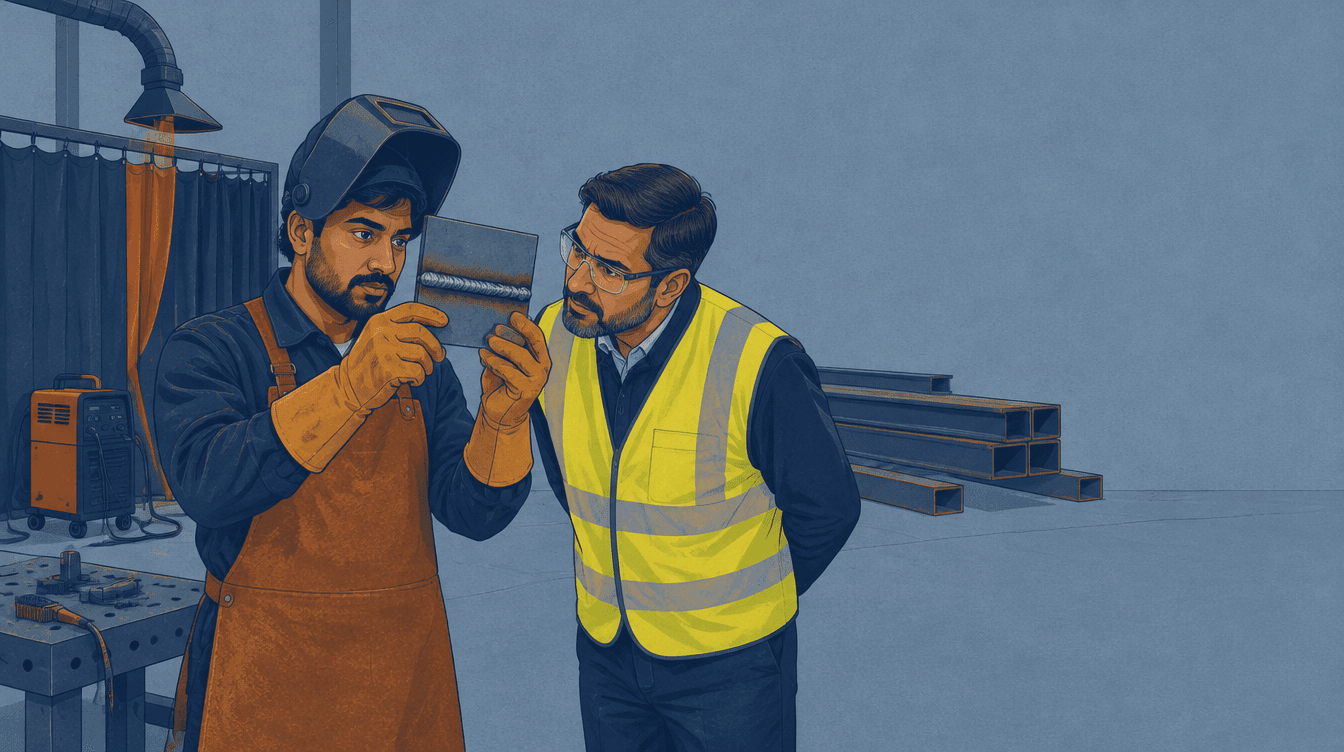
You can hire experienced welders from India, Nepal, the Philippines and elsewhere in Asia, and many EU fabricators do. The welder is rarely the hard part. What decides whether the hire works is three things, in this order: whether the welder's certificate covers the work you actually do, whether you have seen them weld before they travel, and which permit route your country offers for the job and the pay you are offering.
Get those right and the rest is administration. Get them wrong and you can lose months to a permit that stalls, or receive a welder who is certified on paper for a process your shop does not use. This guide sets out what to check, in the order you should check it.
The certificate: what EN ISO 9606 tells you, and what it does not
Most welders recruited for EU work will hold, or will need, a welder qualification test certificate to EN ISO 9606 (part 1 for steels). It is a narrow document by design. It records that one person produced a sound weld in a specific process, material group, product form, thickness range and position, on a specific date, witnessed by an examiner or examining body.
That narrowness is the point. A certificate for MAG fillet welds on plate in the flat position says nothing about TIG root runs on pipe in a fixed position. When you read a candidate's certificates, read the scope lines, not the headline:
- Process — for example 111 (MMA/stick), 135 (MAG), 141 (TIG). Match it to your welding procedure specifications.
- Product form and joint — plate or pipe, butt or fillet.
- Material group and thickness range — carbon steel is not stainless.
- Position — overhead and fixed-pipe positions are where many candidates fall short.
- Issuer and date — who examined the test, and whether you can verify it with them.
A certificate also has to be kept alive. Certification bodies such as Kiwa describe validity being extended in six-month periods where the welder has worked continuously within the scope, and a full certificate running two or three years depending on the standard used. A welder who has spent a year out of the trade, or whose certificate has lapsed, may need to be re-tested before they can weld production work for you.
In practice, many EU employers treat an Asian-issued certificate as evidence that a re-test is worth running, not as a substitute for one. Your welding coordinator will usually want to qualify the welder under your own quality system once they arrive. Plan for that week in the induction.
Vocational qualification is a separate question
Do not confuse the welder test certificate with the welder's vocational qualification: the trade certificate or diploma from a training institution. Immigration authorities look at the second, not the first. This matters most in Germany, where the route for a skilled worker runs through the qualification itself. We cover that process in detail in getting a welder's qualification recognised in Germany.
Ask for both documents at the first screening, as originals, together with a work history you can check by phone.
Test them before they travel
A CV and a certificate are claims. A test coupon is evidence. The single most useful thing an employer can do is insist on a practical trade test in the source country, set to your own requirements:
- Send your specification. Process, material, thickness, joint type and position, ideally taken straight from the welding procedure specification the person will work to.
- Weld the coupons under supervision. Same consumables and positions as your shop, with the candidate's identity checked against their passport on the day.
- Inspect them properly. Visual inspection at minimum; bend tests, macro sections or radiography where the work demands it.
- Record everything. Photographs of the coupons, inspection notes and, where useful, video of the candidate at work, so your coordinator can decide without travelling.
- Interview the shortlist yourself. In person or by video, covering the work, the country and the conditions.
This is how we run trade testing; the detail is in how we assess welders, electricians and drivers before they get on a plane. Expect to reject most candidates. A hard test at the start is far cheaper than a welder who cannot pass your own re-test in week one.
Choose the permit route by country
Once you have a welder you want, the route depends on where they will work and what you will pay.
Lithuania. Hiring runs through the employer's mediation letter and a temporary residence permit or national D visa. The critical point for 2026 is the quota. LRT reported that the Migration Department considered the 24,700-place quota effectively exhausted on 30 July 2026. Since then, employment-based permits are issued only where pay is at least 1.2 times the national average gross wage (reported as €2,893 a month), or at least the average wage (€2,411.40) for high-value-added occupations that are on the shortage list. For the rest of 2026, budget a welder offer at those levels or plan the start for the 2027 quota. Background: the quota explained and the mediation letter. Country overview: hiring in Lithuania.
Poland. The employer applies for a type A work permit. Since June 2025 applications are made only electronically through praca.gov.pl, and the employer must file a signed copy of the written contract, with a translation the worker understands, before the work starts, according to Grant Thornton's summary of the new rules. See hiring in Poland after the 2025 reform.
Germany. Besides full recognition, the visa for professionally experienced workers suits many experienced welders. It needs a vocational qualification of at least two years' training recognised in the country of origin, at least two years of relevant experience in the last five, and a 2026 salary of at least €45,630 gross a year, unless the employer is bound by a collective agreement and pays according to it. For a worker over 45 the threshold rises to €55,770, unless they can show adequate pension provision.
Latvia. The employer first publishes the vacancy with the State Employment Agency and obtains its opinion, then has the migration office approve the invitation, and the offered wage must meet the sector average. The full process is in our Latvia work permit guide.
A realistic timeline
Count in months, not weeks. The sequence is fixed even where the durations vary:
- Agree the requirement: process, positions, headcount, pay, accommodation and start date.
- Source and trade-test in the source country.
- Prepare the employer documents and file the permit or visa application.
- Wait for the decision and the visa appointment.
- Travel, registration and arrival.
- Re-test under your own quality system and start production work.
A common and avoidable delay is a mismatch discovered late: a welder certified on plate when the job is pipe, or a salary that does not meet the threshold for the route you chose. Fix both at step 1. For more on the roles we fill, see our welding sector page.
Where ManBe fits
ManBe recruits and trade-tests welders in Asia for EU employers, for direct employment only: every welder joins your own payroll, on your own contract, under your own welding coordinator. We help prepare the documents your country's route requires, but the permit decision rests with the authorities. Rules change often, and this guide reflects the position as of November 2026. To discuss a requirement, start at our employer page.
FREQUENTLY ASKED
- Yes. Employers in Lithuania, Latvia, Poland, Germany and other EU countries hire non-EU welders through national work permit or skilled-worker routes. The worker is employed directly on the employer's payroll, and the route and pay threshold depend on the country.
- It certifies that one welder produced a sound weld in a specific process, material group, product form, thickness range and position. It does not cover other processes or positions, so employers should check the scope lines against their own welding procedure specifications.
- Often not on its own. Many EU employers re-qualify a new welder under their own quality system after arrival, and a certificate that has lapsed or does not match the work will need a new test. A supervised practical test before departure reduces the risk of a failed re-test.
- The test certificate shows that a person can produce a particular weld. The vocational qualification is the trade certificate or diploma from a training institution, and it is what immigration authorities, especially in Germany, assess for skilled-worker routes.
- Yes, if the pay meets the higher threshold. LRT reported that after the quota was effectively exhausted on 30 July 2026, employment permits require pay of at least 1.2 times the average gross wage, or at least the average wage for high-value-added shortage occupations.
More from the blog

Hiring non-EU construction workers in Latvia: pay, permits and site rules
Latvia's construction sector has its own minimum wage, overtime rule and site time-recording system. Here is what employers need to line up before hiring trades from outside the EU.

Hiring factory and food-processing workers from outside the EU
How manufacturers and food plants can hire non-EU workers: defining the roles, permits after Lithuania's 2026 quota closed, food hygiene training, legal shift patterns and housing.
Hiring non-EU bus and coach drivers in Lithuania: licence, code 95 and pay
Hiring bus and coach drivers from outside the EU in Lithuania: why the licence exchange and code 95 set the start date, and the pay threshold now that the 2026 quota is used up.